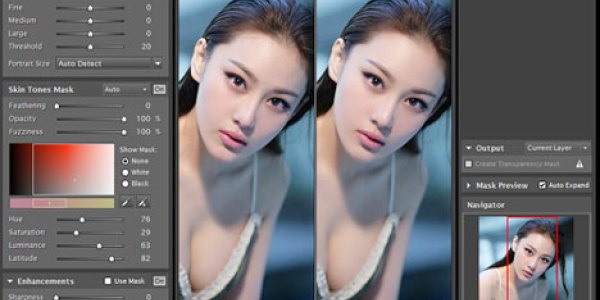
Imagenomic Portraiture - consider
Download Imagenomic Portraiture 3.5 for Adobe Photoshop and Lightroom free latest full version direct download link one-click standalone offline installer for Windows 32-bit and 64-bit. Imagenomic Portraiture for Photoshop 2021 v3.5.4 is a powerful Plugin for Photoshop and Lightroom providing a comprehensive set of tools for processing and retouching the images accordingly.
Imagenomic Portraiture 3.5.4 for Adobe Photoshop Review
A comprehensive Photoshop Plugin, Imagenomic Portraiture 2020 v3.5.4 comes with a variety of powerful tools for retouching photos. It is a powerful application with a professional environment that allows the users to take care of all the operations with great ease. It provides seamless integration with Adobe photoshop and provides a comprehensive set of tools for processing digital images. Also, it provides the ability to work with the texture, color, and various other aspects of the images. Also, it provides a powerful solution with an advanced set of tools that enhances the workflow. This powerful application delivers a variety of features and options for producing accurate results. You can also download Adobe Photoshop CC 2020 v21.2.4

Moreover, it comes with various adjustments for the images and provides support for finally adjusting the color, light, and contrast of the images. It also provides the ability to work with the tissues and wrinkles as well as other details. This powerful application delivers complete support for handling the colors as well as provides various image details. Retouch and repair the images as well as repair the facials and other image problems. Removes wrinkles and tissues as well as enhance the images to get clean output. Improve the visual appearance of photos and apply various effects and create various color effects. All in a nutshell, it is a powerful Photoshop and Lightroom plugin to enhance digital images with great ease. Beautify for Adobe Photoshop 1.6 is also available for download.

Features of Imagenomic Portraiture 3 for Photoshop
- The powerful image editing application
- Allows the users to retouch the images
- Apply various effects and enhance the images
- Customize color and various other image details
- Remove any imperfections from the images
- Improve the visual appearance of the digital images
- Choose the body texture and make use of various filters
- Remove wrinkles and tissue problems
- Retouch and repair the faces
- Seamless integration with Adobe Photoshop
- Improved performance and enhanced productivity
- Detect various image issues and fix face problems
- Parallel processing to save time
- Numerous tools for auto repairing of images

Technical Details of Imagenomic Portraiture 3.5.7 for Lightroom
- Software Name: Imagenomic Portraiture 3.7 for Photoshop and Lightroom
- Software File Name: Imagenomic_Professional.rar
- File Size: 17 MB
- Developer: Imagenomic
System Requirements for Imagenomic Portraiture 3.5.7 for Adobe Photoshop
- Operating System: Windows 10/8/7
- Free Hard Disk Space: 1 GB of minimum free HDD
- Installed Memory: 1 GB of minimum RAM
- Processor: Intel Core 2 Duo or higher
- Adobe Photoshop CC 2015.5 or higher
Imagenomic Portraiture 2021 v3.5.7 for Adobe Photoshop and Lightroom Free Download
Click on the below button to get the latest full version direct download link one-click standalone offline installer of Imagenomic Portraiture 2020 v3.5.4 for Windows x64 architecture.
Imagenomic Portraiture 2021 v3.5.7 for Adobe Photoshop
Imagenomic Portraiture 2021 v3.5.7 for Lightroom
Imagenomic Portraiture 3.5.7 for Photoshop / Lightroom
Free download Imagenomic Portraiture 3.5.7 for Photoshop / Lightroom full version standalone offline installer for Windows PC,
Imagenomic Portraiture Overview
Imagenomic Portraiture is a Adobe Photoshop CC or Elements that eliminates the tedious manual labor of selective masking and pixel-by- pixel treatments to help you achieve excellence in portrait retouching. It intelligently smoothens and removes imperfections while preserving skin texture and other important portrait details such as hair, eyebrows, eyelashes etc.
Features of Imagenomic Portraiture
Multiprocessor support for maximum retouching speed and workflow performance
Enhanced skin masking control that isolates adjustments to just the skin mask, in addition to global adjustments.
Preset power and the flexibility to create, capture and share custom settings with the new Preset Manager
New Preference Settings, including customizable latitude adjustments for mask defaults, and User Interface skins and image display preferences
Auto-updating feature so you always have the latest updates from Imagenomic
Host
Adobe Photoshop
Adobe Lightroom
Version 3
Portraiture 3 features 8/16 bit
RGB/LAB
Only for Photoshop
Smart Filter and Action Support
- Only for Photoshop
- Custom filter preset support
Other
- Any image format for Photoshop
- JPEG and TIFF for Lightroom
System Requirements and Technical Details
Supported OS: OS X 10.10 or later 64-bit
Adobe Photoshop CC 2015.5/ 2017/ 2018/2019
,Program download Imagenomic Portraiture, Download Imagenomic Portraiture, Download Imagenomic Portraiture, Program Imagenomic Portraiture, Imagenomic Portraiture Full activated, crack program Imagenomic Portraiture, program explanation Imagenomic Portraiture
Precise Masking
PORTRAITURE 3
skin retouching
"Most plugins just make claims, Portraiture really works!"
- Katrin Eismann -

Inimitable skin smoothing, healing and enhancing effects plugin.
MAC
Mac OS10.15 - 12..WINDOWS
Windows8 / 8.1 / 10 64-bit..HOST
Adobe Photoshop.Adobe Lightroom .VERSION
Portraiture 3...8/16 bit
RGB/LAB
only for Photoshop
Smart Filter
and Action Support
only for Photoshop
Custom filter
preset support
Any image format
for Photoshop
JPEG and TIFF
for Lightroom
Fast & Advanced
Control
Revamped
User Interface
Predefined
Presets

"Our Studio uses the Portraiture plugin extensively, and we love it... more importantly, our clients LOVE it too!" - Andy Marcus

"Portraiture helps me have stunningly even skin while still maintaining all of the detail. It is essential part of my high-end beauty retouching technique." - Lindsay Adler

"I know more and more pro photographers who are using Portraiture in their retouching workflow because it lets you beautifully smooth skin while still maintaining important texture. They've got some kind of "secret sauce" going on there and while I don't know exactly what it is, I know this - it works!" - Scott Kelby
A portrait plugin for Photoshop
Portraiture is a photography program that was developed by Imagenomic for PC devices. It is a plugin for the popular image editing software, Adobe Photoshop that primarily focuses on skin retouching of subjects in portrait photos. It provides an easy way to make retouches while still providing customizability and flexibility.
Similar portrait retouching photo editors like SkinFiner and PT Portrait are standalone software compared to Portraiture. Instead, it's a plugin that you can integrate directly with Adobe Photoshop, which makes using it much easier and learning it much simple since the interface would already be familiar to you.
How do I use Portraiture?
Using Portraiture is quite easy andintuitive, with a well-organized user interface. When you open an image file, all your control sliders are located on the left side and are divided into three main sections. First, Smoothing will let you apply various smoothing effects to your photos, and you have full control of how strong or how subtle they can be.
Second, you have Skin Mask section, which allows you to adjust the skin tones in your subjects, as well as having sliders to tweak for feathering, opacity, and fuzziness. Lastly, you have Enhancements that allow you to adjust for sharpness and detail in your photos. Additionally, this is also where you can tweak brightness, contrast, and warmth to suit your tastes.
One nice thing about Portraiture is that you can let it apply automatic retouches to your photos, and the results are often good enough as is. It's available for a one-time purchase, or as a free upgrade to existing users. Otherwise, you might want to consider older versions as the newest iteration introduces very few features or improvements to justify its increased price.
Effective skin retouching tool
All in all, If you are an existing Portraiture user, its latest version is a worthwhile free upgrade to have the newest features and improvements, no matter how few they are. If you're a newcomer though, this tool is one of the best options to consider for its performance and ease of use.
Noted: No Item will be posted out, only digital download will be sent through email after Payment Confirmation or after 24 hours done payment. *Purchase from Shopee *Provide Your Gmail to us *NO REFUND (At your own risk) *Do not expect me know everything about every softwares function or how to use, u can google how to use or test it yourself, I got more than 1000+ softwares and games to test. Image-nomic Portraiture 3 plugin for Photoshop and Lightroom it eliminates the tedious manual labor of selective masking and pixel-by-pixel treatments to help you achieve excellence in portrait retouching. Image-nomic Portraiture 3 for Photoshop and Lightroom Overview: Imagenomic Portraiture is a Photoshop CC or Elements that eliminates the tedious manual labor of selective masking and pixel-by- pixel treatments to help you achieve excellence in portrait retouching. It intelligently smoothens and removes imperfections while preserving skin texture and other important portrait details such as hair, eyebrows, eyelashes etc. Portraiture is built on the core technology and feature set of the original Portraiture Plugin, and will take your skin retouching workflow to the next level of performance, quality of results and overall ease of use. Dare we say, our Image-nomic Portraiture Plug-in will continue to transform the industry by enabling virtually all skill levels to achieve excellence in skin retouching across the spectrum of image subjects and production challenges, including portrait, full body, group shots, advertising, fashion, beauty, medical, and motion imagery, and without the familiar constraints or learning curves associated with other software products, plug-ins or digital retouching techniques. Features of Image-nomic Portraiture 3 for Photoshop and Lightroom: - Multiprocessor support for maximum retouching speed and workflow performance - Enhanced skin masking control that isolates adjustments to just the skin mask, in addition to global adjustments. - Preset power and the flexibility to create, capture and share custom settings with the new Preset Manager - New Preference Settings, including customizable latitude adjustments for mask defaults, and User Interface skins and image display preferences - Auto-updating feature so you always have the latest updates from Image-nomic *Plugin should be at Edit In>> Potraiture 3 System Requirements and Technical Details: Photoshop CC 2015.5/ 2017/ 2018/2019 Supported OS: Windows 7/8/10/11 (64bit) RAM: 8 GB or more recommended Free Hard Disk Space: 80 GB or more
Version 2’s skin healing, smoothing, and enhancing software is now available in Version 3. It has twice the performance and twice the speed. Plus, it produces consistent and pleasant retouching results. Other improvements include an improved interface that makes navigation easier and allows for faster handling of large images shot with high-megapixel camera models. Portraiture 3’s main draw is not its user interface, as beautiful as it is, but the skin smoothing performance.
Imagenomic Portraiture 3
We are focused on developing high-performance software tools that can be used to correct image enhancement and retouching. Our products are highly regarded by industry peers and customers worldwide for their outstanding processing speed, image quality, and ease of use. Portraiture 3 is compatible with both the most recent versions of Mac OSX, Windows, and Adobe(r] Photoshop(r] CC. Imagenomic has just completed a large public beta testing phase for Portraiture 3. There were over one thousand participants. Imagenomic’s new plugin product received an overwhelmingly positive response from all segments of the photographic and retouching community, with enthusiastic feedback coming in from educators and photographers as well as some of the most respected and respected photographers. You can download the Imagenomic Portraiture 3 plugin free for Adobe Photoshop and Lightroom. It eliminates tedious manual labor involved in selective masking and pixel-by-pixel treatments, allowing you to achieve exceptional portrait retouching.
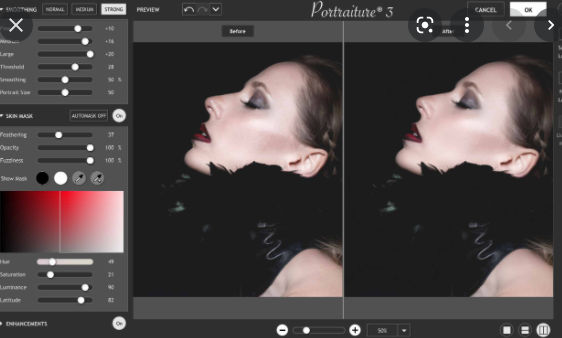
Portraiture is a Photoshop plugin that provides advanced skin retouching tools. You can use the eyedropper tool to choose different skin tones from an image. There are also hue, saturation, and luminance sliders that allow you to fine-tune a particular mask. The mask can be viewed with either black or white underneath. This will show you the areas where adjustments have been made. You can zoom in or out using the slider at the bottom of your window. However, you can also choose from a drop-down menu of percentages.
Portraiture 3 Review: Imagenomics New Version Of Portraiture Is A Great Portrait Plugin For Photoshop
It’s simple to apply the mask to an image by simply putting the results in its own layer. For example, I might reduce Portraiture 3’s effects on the lips and around the eyes. Our desktop editions are available in standalone or plugin versions. They feature intuitive controls that can be used by both professional and consumer users. The Software Development Kit allows Imagenomic to be integrated into third-party products or vertical industry applications. Improved skin masking control which isolates global adjustments from the skin mask.
You will also find an “enhancements” section that includes presets such as “glamour” and various sliders including sharpness and softness. Although you might enjoy the sliders, I think there are better ways to adjust Photoshop beyond the Portraiture 3 plugin. They are useful and appreciated by those who use them. However, the true draw is their skin smoothing capabilities. It may be useful to tweak the enhancement sliders that are applied to specific areas of the skin. Portraiture 3 is fast and easy to achieve great portrait retouching results. However, it can be quite expensive. It depends on how many portraits you need to retouch regularly and how important it is to you to cut down on your workflow.
Although you can make the default color lighter, I prefer the darker one. This software is extremely powerful, as you’ll see in the next section. This file was scanned using VirusTotal, which has more than 70 antivirus software products. No threats were found. View of all sliders in 100% with their default values of “0” and the Auto Mask applied.
You can get a free trial if you are still unsure. Portraiture 3 is a great plugin for those who want a simple, efficient way to retouch portraits. It also allows you to smoothen skin and retain fine-tuned control whenever it’s needed. It is compatible with non-destructive Photoshop workflows, which is important for many photographers.
Imagenomic Portraiture: 3 Features
This could be because the program has been discontinued or there is a security problem. Some reports suggest that this program may be malicious or install unwanted bundled software. These false positives could mean that users should be cautious when installing this software. Software and games that are commercially produced are usually for commercial use.
The software renders soothing effects and other effects when you zoom out. It is not easy to change from the default best fit to view your image at full-size or larger. The plugin was slow when working with large TIFF files of the Fuji GFX. To determine if the slow speed was due to the combination of large files and my admittedly old computer, I opened smaller files taken from other cameras. The plugin was quite fast.
Customer Support Center is the best place to get support and questions regarding the software. Portraiture 3 is compatible with the most recent versions of Mac OSX, Windows, and Adobe Photoshop CC. The upgrade is free for existing Portraiture 2 users and $199.95 for new users. You can download freeware programs and use them without restrictions. You can use freeware products for personal or professional use. Here are the main features that you will discover after downloading Imagenomic Portraiture for free.
It was difficult to create a skin mask that captured the light and shadow areas of the skin. The RealEffects skin toning and coloring are unmatched in portraiture.
The trial period ends and the user has the option to decide whether or not to purchase the software. Although most trial software products have a limited time period, some may also have limitations in terms of features. This license is most commonly used to play video games. It allows users to download the game and then use it for free. The product is free to play and the user has the option to purchase additional features, virtual goods, or services that will enhance the game’s functionality. You can also adjust the threshold. I found that my skin looked more natural when I increased the threshold to the maximum.
Imagenomic Portraiture 3 System Requirements
- Adobe Photoshop
- CC 2015.5 / 2017/2018
- Adobe Lightroom
- CC 2015 / Classic CC
SKIN RETOUCHING BASICS AND USE OF PORTRAITURE PLUGIN BY IMAGENOMIC 2007 Skin Retouching Basics and Use of Portraiture Plugin Skin Retouching Basics and Use of Portraiture Plug-in Updated February 2, 2007 Contact Imagenomic at http://www.imagenomic.com/contact Copyright © 2004-2007 Imagenomic, LLC. All rights reserved 2 Copyright© 2004-2007 Imagenomic LLC. All rights reserved. All product and company names referenced herein are trademarks of their respective owners. Skin Retouching Basics and Use of Portraiture Plug-in Copyright© 2004-2007 Imagenomic LLC. All rights reserved. 3 All product and company names referenced herein are trademarks of their respective owners. Skin Retouching Basics and Use of Portraiture Plugin TABLE OF CONTENTS SKIN RETOUCHING BASICS AND USE OF PORTRAITURE PLUGIN.............................. 4 INTRODUCTION.................................................................................................................................................. 5 PLUG-IN CONTROLS......................................................................................................................................... 10 SKIN TONES MASK............................................................................................................................................ 12 PARAMETER BRACKETING.................................................................................................................................. 18 ACTIONS AND SCRIPTING.................................................................................................................................20 4 Copyright© 2004-2007 Imagenomic LLC. All rights reserved. All product and company names referenced herein are trademarks of their respective owners. Skin Retouching Basics and Use of Portraiture Plug-in SKIN RETOUCHING BASICS AND USE OF PORTRAITURE PLUGIN Note: All color images used in this reference tutorial are 8bit sRGB images converted from RAW using various Canon DSLRs. Copyright© 2004-2007 Imagenomic LLC. All rights reserved. 5 All product and company names referenced herein are trademarks of their respective owners. Skin Retouching Basics and Use of Portraiture Plugin INTRODUCTION There are many books, articles and web based tutorials on the art of retouching the human skin. In general, most of these deal with the concept that skin colors all fall within a given range based on the race of the subject. While this is a generalized concept, it is difficult to apply this idea to skin retouching in a realistic manner. Using such concepts and applying the normal tools available to us in our digital editing programs, we tend to get widely varying results even among supposedly similar images. In our development of the Portraiture plug-in, we've discovered quite a few unique things about the composition and digital portrayal of human skin. We have done this through careful, detailed analysis of thousands of images shot in various lighting scenarios, as well as by actually taking skin color samples with specific hardware. We have found that there is a vastly varying tonality to the human skin, even within the range of one person's body. Figure 1 and the resulting RGB chart in Figure 2 (below) show such a sampled variation, which further proves that even though there are no significant differences in the RGB values of each skin color patch, our eyes can perceive a lot of variation due to the lightness and darkness of each patch, and not just the actual color. 6 Copyright© 2004-2007 Imagenomic LLC. All rights reserved. All product and company names referenced herein are trademarks of their respective owners. Skin Retouching Basics and Use of Portraiture Plug-in (Figure 1) (Figure 2) Copyright© 2004-2007 Imagenomic LLC. All rights reserved. 7 All product and company names referenced herein are trademarks of their respective owners. Skin Retouching Basics and Use of Portraiture Plugin With the obvious variations that we have in skin colors from a typical sampling, you can see why skin retouching can have so many variables. Good retouching does not just rely on color, though tonality or contrast of color plus texture are very, very important to achieving realistic, glowing skin. Current methods of retouching usually rely on some form of blurring to minimize blemishes and harshness of skin. There are numerous methods in use, but all require a series of complex steps and none can be batch processed with much success. For these and related reasons, Imagenomic designed the Portraiture plug-in to alleviate the tediousness and repetition of skin retouching. Portraiture runs as a plug-in from within Adobe Photoshop Elements and Creative Suite and will work in 8 or 16 bit modes. This plug-in's unique skin selections masking and smoothing algorithms go beyond the available tools in any image editor to easily achieve a look that often requires complicated selections and layer masks. In addition, the Portraiture plug-in can be batch processed from within an action, thus automating a hand process that could take hours otherwise. There are various levels of retouching, from extreme makeovers to minor blemish removal. In this tutorial, we will be utilizing a typical head shot portrait with a wide enough range of blemishes to give a good idea of how to accomplish such a retouch quickly. To start, we highly recommend that some sort of calibration routine be done to your monitor to give a better rendition of onscreen colors. There are numerous devices that do this and there are also methods using the “old Mark II eyeball”. Also, your lighting environment can play a big role in the perception and final output of your images. What may look good on your screen may not print well or look good on someone else's system. If you are very serious about your imaging, a device like the Gretag Macbeth Eye-One Display 2 colorimeter is cost effective and very simple to use. It will not only calibrate your monitors, but measure ambient lighting as well. A little background in image portrayal is necessary to help you better understand what you are trying to achieve. Imperfections or details in an image are dependent mainly on viewing distance. Images, whether printed or viewed on a monitor, can be over scrutinized or as it is known in the industry, 'pixel peeping'. This occurs mainly when images are viewed at 100% or larger zoom size on a 8 Copyright© 2004-2007 Imagenomic LLC. All rights reserved. All product and company names referenced herein are trademarks of their respective owners. Skin Retouching Basics and Use of Portraiture Plug-in monitor and all the tiny details and imperfections that aren't viewable at a normal screen or print size jump out at you. If you try to edit your image based on these views, you end up 'chasing your tail' and can quickly become frustrated because the image on the monitor at normal viewing size or on a normal sized print will look over-processed. A general rule of thumb is to set your preview to 100% for a web sized image and to an appropriate percentage that correlates your screen preview to your print size. For example, on most screen resolutions, an 8x10 300DPI image will look about the same size on the screen at 25% preview size as the print will be. So you would be wasting your time trying to remove excess imperfections at 200% on the web based image or 100% on the print image. So, with that in mind let's begin to see what we can do with a typical head & shoulders portrait retouch. First, we are going to be working on a Canon 10D RAW image, processed with RawShooter Pro at 8bit, 8x10 300 DPI (Figure 3). We are going for subtlety here, by minimizing the blotchiness in the face as well as minimizing the freckles on the arm and shoulder. In the average portrait, this is a very typical scenario. Copyright© 2004-2007 Imagenomic LLC. All rights reserved. 9 All product and company names referenced herein are trademarks of their respective owners. Skin Retouching Basics and Use of Portraiture Plugin (Figure 3) A few good Photoshop habits to get into are to always work on a duplicate of the original, set snapshots before each major retouch change, and use layers as needed. It is beyond the scope of this tutorial to elaborate on maximizing your PS use and we suggest any number of books or web tutorials on this subject. As there are no major retouching issues with this iparticular mage, we will run the Imagenomic Portraiture plug-in. Before we do so, we need to clarify a few things about the plug-in interface and usage. There are basically two ways to run the plug-in: with or without a transparency mask. We will be using a transparency mask in this discussion, so first we must duplicate the current background layer using CMD-CTRL J or Layer-Duplicate Layer. Run the Portraiture plug-in (Filter- Imagenomic-Portraiture) and then select the Default settings to give a starting 10 Copyright© 2004-2007 Imagenomic LLC. All rights reserved. All product and company names referenced herein are trademarks of their respective owners. Skin Retouching Basics and Use of Portraiture Plug-in point. Make sure the 'Create Transparency Mask' checkbox in the lower right part of the plug-in screen directly above the navigator is checked. When using the plug-in, zoom to the preview size that dictates your output (per the information we discussed earlier). If the output is intended to be an 8x10 300DPI print, zoom to 25%; if output is for the web, zoom to 100%. You should use the split -before and after- preview, either vertical or horizontal, to get an idea of how the settings are affecting the image (Figure 4, below). (Figure 4) Copyright© 2004-2007 Imagenomic LLC. All rights reserved. 11 All product and company names referenced herein are trademarks of their respective owners. Skin Retouching Basics and Use of Portraiture Plugin PLUG-IN CONTROLS The Portraiture plug-in controls are laid out in an easy to understand and usable manner. We will briefly go over them so you will be somewhat more familiar with the usage of each control. The first section in the upper left of the screen is the Settings dropdown list (Figure5, below). There are some pre-defined settings available and you can always create your own and save them by clicking on the small disk icon to the right of the dropdown arrow. Up to 40 custom presets may be saved to disk and you may call them whatever you like. We will begin by selecting the Default setting. This sets all sliders to zero with the exception of the Threshold which is set to 20. (Figure 5) The next area is Detail Smoothing which is divided further into 2 sections (Figure 6, below). Detail smoothing contains the controls that govern the amount of smoothening that is applied to the image. “Fine” works with very small details like skin pores, “Medium “with larger details like skin blotches, and “Large” works on bigger areas of blotching. As blemishes usually are of a fine nature, the Fine and Medium sliders will have the most noticable effect on the average skin. 0 (zero) is used as a middle level of each range with negative values meaning less and positive values meaning more. Extreme left on each slider is no effect and extreme right is maximum effect. 12 Copyright© 2004-2007 Imagenomic LLC. All rights reserved. All product and company names referenced herein are trademarks of their respective owners. Skin Retouching Basics and Use of Portraiture Plug-in (Figure 6) The second part of Detail Smoothing is Portrait Size (Figure 7, below). Portraits of varying sizes need to have the smoothening applied to allow maximum detail. A small, web based image will not need the same type of smoothening applied that a large print will require. This comes in handy if you make web based or small proofs. You can just tweak one series of Portraiture slider settings and then have an action run that would work on either large or small images by setting the Portrait Size to Auto Detect. These settings should basically correspond to the size of the image when you run Portraiture as this is not meant to resize anything. If you're using small web based images, set the Portrait Size to either Auto Detect or Small. On occasion, you may want to experiment a bit by setting Portrait Size to a different setting other than your image size or Auto, as this opens up more possibilities for creativity. (Figure 7) Copyright© 2004-2007 Imagenomic LLC. All rights reserved. 13 All product and company names referenced herein are trademarks of their respective owners. Skin Retouching Basics and Use of Portraiture Plugin SKIN TONES MASK The Skin Tones Mask area is next and is the heart of Portraiture. This is where you refine the selection of your image skintones. The Apply "Detail Smoothing" to Skin Tones Only checkbox determines whether or not you want to smooth only skintones or the whole image. Further in this tutorial, we will discuss how this particular feature can be used for some artistic creativity! For now, we want to make sure the box is checked and that the Mask Opacity is set to 100%. The Mask Opacity works similar to that in most any graphics editor, in that it sets the overall transparency level of the generated mask (Figure 8, below). (Figure 8) 14 Copyright© 2004-2007 Imagenomic LLC. All rights reserved. All product and company names referenced herein are trademarks of their respective owners. Skin Retouching Basics and Use of Portraiture Plug-in The Show Mask radio buttons, “White” and “Black”, are used to show an actual transparency mask of selected colors using the color pickers and/or the Hue, Saturation, Luminance and Latitude sliders. “None” turns off the mask and shows the image as is with current settings applied. The White button, when selected, will show the mask with all transparent areas showing through as white (Fig 9, left). The Black button will do the same thing but all transparent areas will be black (Fig 9, right). Also, the M key on the keyboard will toggle the white mask button on and off. This can be quite convenient when fine tuning a skin tone mask. (Figure 9) Copyright© 2004-2007 Imagenomic LLC. All rights reserved. 15 All product and company names referenced herein are trademarks of their respective owners. Skin Retouching Basics and Use of Portraiture Plugin The Hue, Saturation, and Luminance control the values of selected colors, and the Latitude slider controls how many colors from the original selection are within range. By looking at Figure 8 (above), the color box in the middle of the dialog reflects the currently selected latitude range, while the color bar directly below it shows an approximation of the hue or color itself. The white squares in each part, both the box and bar, can be dragged around by click holding the mouse. Also, each square can be used to expand or shrink its corresponding range by clicking and dragging on an edge of the white square. Try clicking the small white square in the lower color bar and moving it back and forth. Note that only the Hue slider will move and the colors in the box above will change to reflect your position. If you place your mouse cursor on one of the white edges of the square, it will change to a double arrow which indicates you can then drag the edges of the box either way to expand the latitude. This process works the same way for both boxes. Try it on each one and watch the results. Sometimes, it can be easier with a tricky tonal range to select colors using this method. The Enhancements section globally adjusts various listed parameters. These settings affect the whole image and not just the skintone mask. These settings can be used creatively or to just add that extra pop to your images. Sharpness uses a high quality edge enhancing algorithm to add some additional definition to image edges. Softness is similar to a gaussian blur but is more subtle and can be used to enhance that glamour look. Warmth adds a nice even warm tint overall. Brightness will work on the luminance channel of the image to overlay some added brightness and works well in conjunction with the Contrast slider to pull in some negative or positive contrast for subtle tonality changes. 16 Copyright© 2004-2007 Imagenomic LLC. All rights reserved. All product and company names referenced herein are trademarks of their respective owners. Skin Retouching Basics and Use of Portraiture Plug-in (Figure 10) Now we can get down to business! Make sure the checkbox is checked in the Skin Tones Mask for "Detail Smoothing" (Figure 8, above). This is a important, as we only want to work with selected skin colors and not the image as a whole. Set Mask Opacity to 100% and make sure the Show Mask:None radio button is selected. Also, double-check to make sure the 'Create Transparency Mask' checkbox in the lower right part of the plug-in screen directly above the navigator is checked. In the Skin Tones Mask section, click the left most eye dropper directly to the right of the color selection box. This dropper selects a single color that can be further enhanced with the various controls ,or added to with the plus dropper which is the one to the right with the plus symbol beside it. Move this dropper over an area of skin and watch the HSL and RGB readouts reflect the values under the dropper. HSL stands for Hue, Saturation and Lightness and is another method of showing color data that is very accurate. As you move the cursor around, you will notice that the H will show 'Not a skin color' and this just means that the area under the dropper is not normally associated with skin tone ranges. This can help you in deciding what areas are usually selected as skin tones and what areas can be ignored. As we saw at the beginning, skin tone values can vary greatly, even over small areas of skin. For facial skin selections, a good starting point can be the upper center of the cheek or the middle of the forehead. Some things to avoid when selecting a skin tone are shadows, specular hilites or hotspots, heavy colored makeup , hair, eyebrows/lashes, jewelry or clothing. Click a skin area that you feel is average for your image to start. The preview will immediately update to reflect your selection. If you do not notice any change in your image, you may need to zoom in a bit. Also, you may have selected a color that doesn't permeate throughout the skin, or you may have your Threshold slider set to zero or very low. One other thing that may have happened is that you might have accidentally set your latitude very low in the Skin Tones Mask dialog (Figure 8, above). To find out exactly what color range you have selected, just press the M key or click the White or Black radio button in the Skin Tones Mask dialog. Your selected range will then show up and you can better determine if the Copyright© 2004-2007 Imagenomic LLC. All rights reserved. 17 All product and company names referenced herein are trademarks of their respective owners. Skin Retouching Basics and Use of Portraiture Plugin selection meets your needs. While holding down the M key, you can further add colors to the mask by clicking in areas of the image that you want to use. The mask will expand to reflect your choices automatically. 18 Copyright© 2004-2007 Imagenomic LLC. All rights reserved. All product and company names referenced herein are trademarks of their respective owners. Skin Retouching Basics and Use of Portraiture Plug-in At this point, the mask results may be a bit confusing, especially to those of you who are not familiar with layer masks in Photoshop. It is not necessary to select every individual color that makes up the skin tones in an image (Figure 11, below). That is the beauty and power that is inherent to good masking technique. A mask, plain and simple, hides or reveals, depending upon its transparency level, whatever is underneath it. In most cases, it is much better to have a mask that allows a bit of the original image to bleed through in various areas. Portraiture's mask generation is superior to any of the currently available tools in standard image editing programs. Because of the way the colors are selected and then smoothed, Portraiture generates results that surpass current methods in use today. (Figure 11) By using the before and after side-by-side or top and bottom preview, you can easily see how much smoothening is being applied. Remember that it is always better to err on the side of too much as we can always reduce it back a bit in our Copyright© 2004-2007 Imagenomic LLC. All rights reserved. 19 All product and company names referenced herein are trademarks of their respective owners. Skin Retouching Basics and Use of Portraiture Plugin editor or further refine it with another mask. Always think about your intended output and make your selections accordingly, and remember to use the zoom features to keep your output in perspective. You can further refine your mask in basically two ways: by using the Detail Smoothing dialog, or by using the Skin Tones Mask dialog. Just remember that the smoothing is totally controlled by the Detail Smoothing sliders, and the range of colors by the Skin Tone Mask Sliders and color box. You will find that you can use the Portraiture plug-in in an infinite number of skin color ranges and smoothening values. At this point, it is a good idea to run several images through the plug-in using various settings. All too often, your perception of a new piece of software can be negatively skewed by just trying one or two test images and not experimenting with the range of settings and the results they produce. The final part of the Portraiture plug-in that we will discuss is the Preview button located just above the left corner of the preview window (Figure 12, below). (Figure 12) 20 Copyright© 2004-2007 Imagenomic LLC. All rights reserved. All product and company names referenced herein are trademarks of their respective owners. Skin Retouching Basics and Use of Portraiture Plug-in PARAMETER BRACKETING Portraiture gives you the ability to add distinct and separate previews that can each have their own settings. This gives you the ability to compare settings to find out what works best for a particular image or to just try out some creativity. A preview can be added with CTRL-N or by right clicking in the preview tab or by left clicking the small arrow to the right of the blue preview button and selecting Add Preview. You can then move back and forth through the previews with the ALT + left and right bracket [ ] keys or click the tabs at the top of the preview window. Parameter bracketing allows you to take the current settings and bracket both up and down from these settings to allow you to compare different levels of slider interaction. This can be an effective way to quickly give you baseline settings for a batch of images that you need to process. It is accessed from the Preview menu by clicking the small arrow to the right of the blue Preview button (Figure 13, below). Bracketing can be also activated by right-clicking on the respective slider controls in the Filter section. (Figure 13) Copyright© 2004-2007 Imagenomic LLC. All rights reserved. 21 All product and company names referenced herein are trademarks of their respective owners. Skin Retouching Basics and Use of Portraiture Plugin 22 Copyright© 2004-2007 Imagenomic LLC. All rights reserved. All product and company names referenced herein are trademarks of their respective owners. Skin Retouching Basics and Use of Portraiture Plug-in In Figure 14, the dropdown list shows the Parameter Bracketing selections that you may use. Each selection corresponds to a specific slider. Whatever value the slider has at time of this selection will be what is used to bracket from; you can also choose to replace previews that are already open or add the new previews to the existing tabs. (Figure 14) Copyright© 2004-2007 Imagenomic LLC. All rights reserved. 23 All product and company names referenced herein are trademarks of their respective owners. Skin Retouching Basics and Use of Portraiture Plugin ACTIONS AND SCRIPTING Portraiture has full support for Photoshop actions and scripting. All adjustable parameters of the plugin will be saved to allow you to create actions/scripts that will allow full automation of your retouching tasks (Figure 15, below). This has powerful implications, especially for those of you that run a lot of images through their shop. A good example is proofing: perhaps you have 40 shots that you want to put up on your LED projector but normally you only retouch 1 or 2 due to time constraints. Now you can setup an action that will do the retouches for ALL of the proofs in just a few minutes as opposed to the hours that it would normally take. The time savings in scenarios such as this, as well as the various aspects of daily use of Portraiture, makes it one of the single most powerful tools that you can incorporate into your imaging workflow. 24 Copyright© 2004-2007 Imagenomic LLC. All rights reserved. All product and company names referenced herein are trademarks of their respective owners. Skin Retouching Basics and Use of Portraiture Plug-in (Figure 15) Copyright© 2004-2007 Imagenomic LLC. All rights reserved. 25 All product and company names referenced herein are trademarks of their respective owners.

You can watch a thematic video
Imagenomic Portraiture 3 Overview TutorialWarning: Undefined variable $z_bot in /home/bilincom/public_html/down/games/imagenomic-portraiture.php on line 175
Warning: Undefined variable $z_empty in /home/bilincom/public_html/down/games/imagenomic-portraiture.php on line 175
0 Comments